Close Search
Sylvia Montoya Weaves the Central Theme at the Terreno Barrio Hotel
- By
Helene Huret
sustainability 2030
off the island
Sylvia Montoya Weaves the Central Theme at the Terreno Barrio Hotel
Jun 22, 2026
by
Helene Huret
Sylvia Montoya Weaves the Central Theme at the Terreno Barrio Hotel
sustainability 2030
off the island
Jun 22, 2026
by
Helene Huret
sustainability 2030
off the island
Sylvia Montoya Weaves the Central Theme at the Terreno Barrio Hotel
Jun 22, 2026
- By
Helene Huret
Sylvia Montoya Weaves the Central Theme at the Terreno Barrio Hotel
Jun 22, 2026
- By
Helene Huret
sustainability 2030
off the island
off the island
sustainability
Sylvia Montoya Weaves the Central Theme at the Terreno Barrio Hotel
Jun 22, 2026
- By
Helene Huret
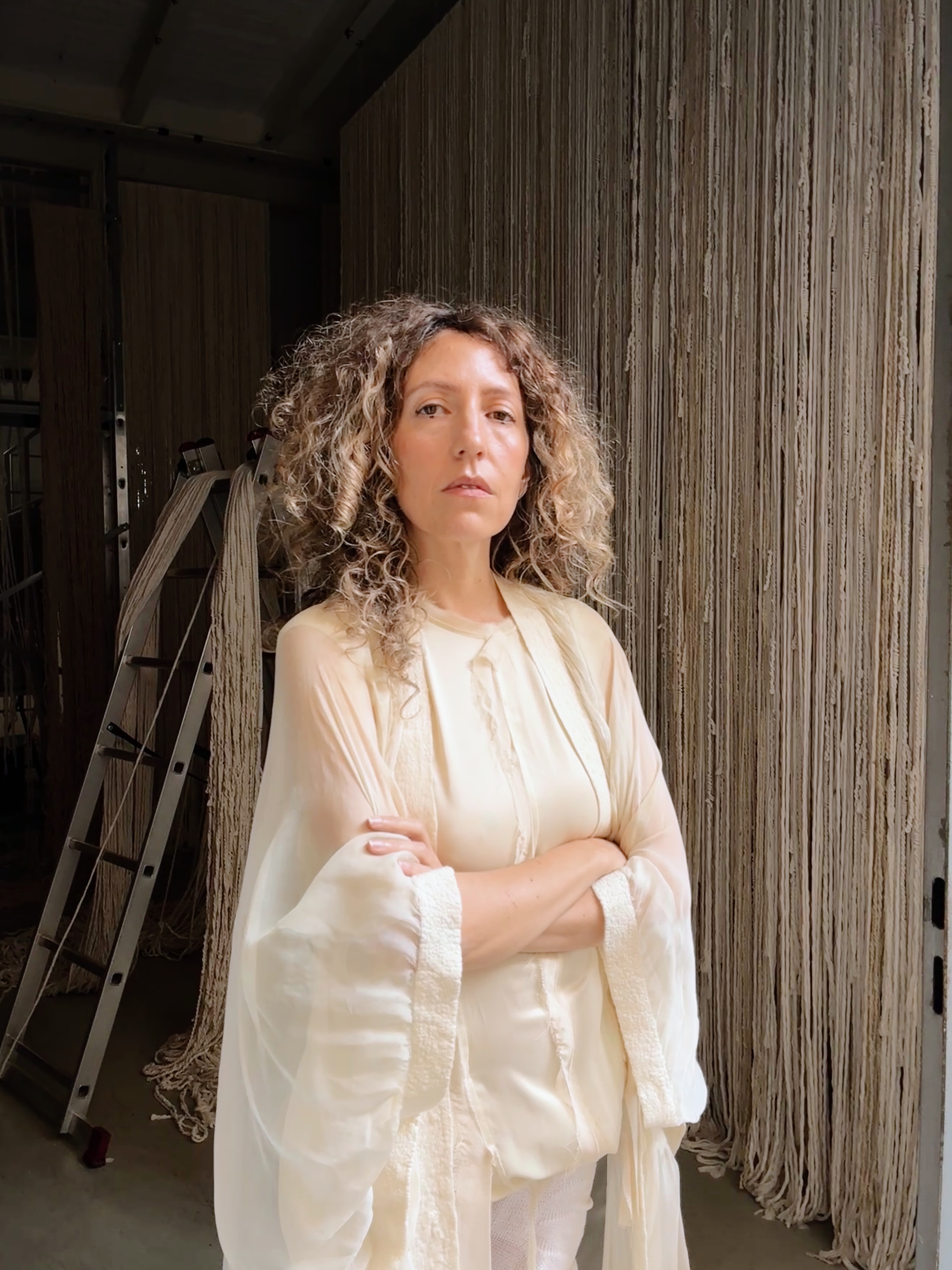
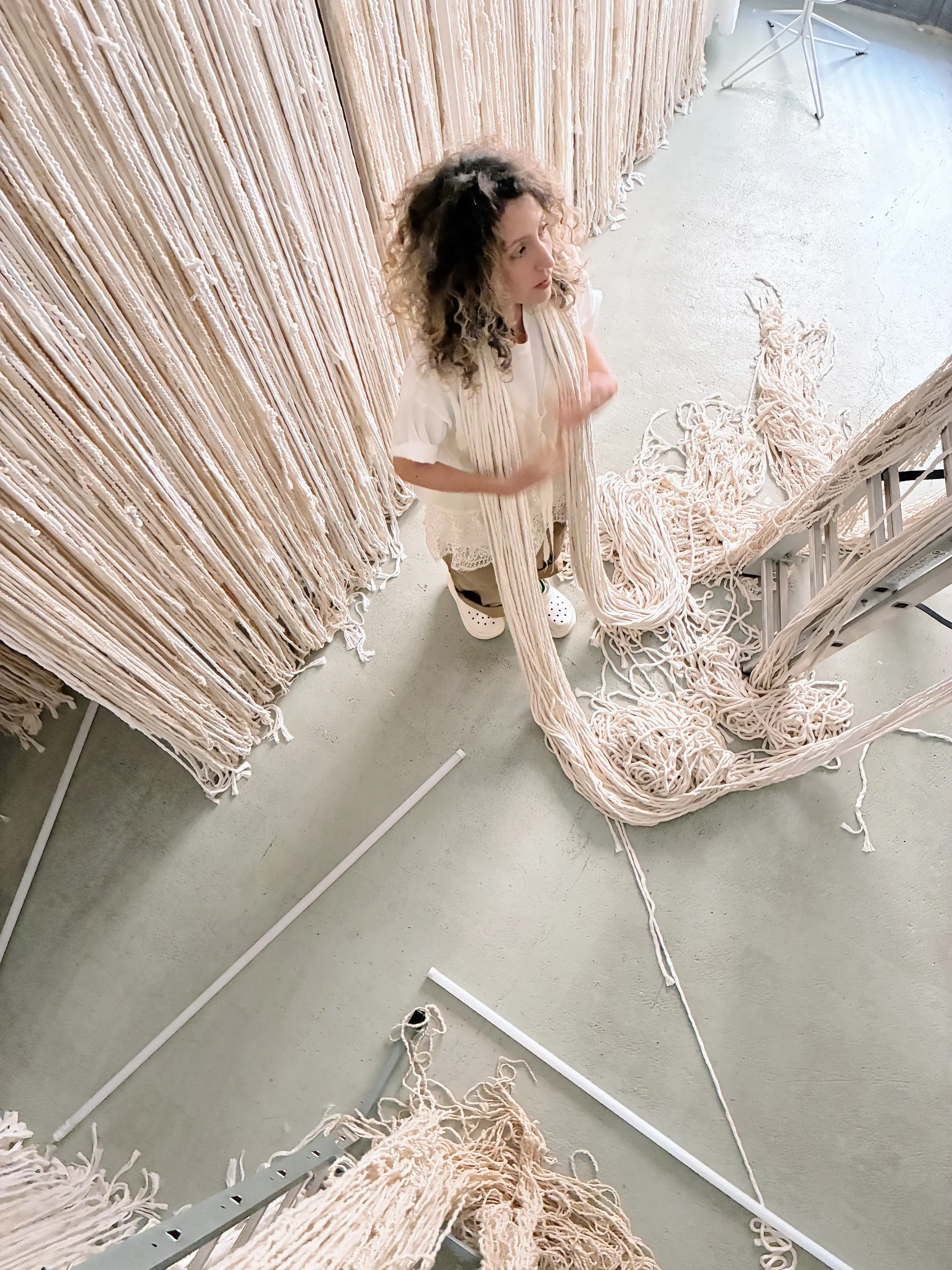
In the studio working on the installation. Photo: Ida Johansson / Opening of Sylvia by Grimalt de Blanch
F

ive years ago, during a dinner, architect Jaime Oliver was bursting with excitement. He had just met an extraordinary artist who, he promised, would create an incredible work of art for their future Terreno hotel. At the time, the OHLAB studio was working on the restoration of a listed building dating from 1935 and the construction, on the neighbouring plot, of a contemporary building designed to complement the Terreno Barrio Hotel, which has just opened its doors.

This project, spearheaded by photographer and filmmaker José Tatavull, is rooted in and draws inspiration from Terreno, an iconic district of Palma’s nightlife that has developed with architectural exuberance, blending styles without any urban planning or long-term vision. Here, colonial-style houses and villas perched on the hillside — whose panoramic views once captivated Joan Miró — stand alongside iconic hotels, guesthouses, former nightclubs, 1960s apartment blocks, narrow alleyways, small houses, and flights of steps leading down to the Paseo Marítimo. Perched on the heights, the neighbourhood offers spectacular views that are being rediscovered with the first renovations in La Gomila. It is this unique location that has inspired the hotel’s core mission: to foster a sense of ‘living together’ among tourists, residents and locals.

‘El Terreno (barrio hotel)’, writes José Tatavull in his manifesto, “is built in opposition to empty tourism, which passes by without seeing, consumes without touching, photographs without understanding, leaves little behind and takes too much away.” We want to create “a hotel where tourists become travellers, where travellers feel like locals, and where locals can gather without feeling displaced.” To bring this ambitious project to fruition and anchor it in its local context and purpose, Jaime Oliver and Paloma Hernaïz  of the Ohlab studio have relied on bold architectural gestures and local talent : Huguet for the terrazzo and cement tiles, La Pecera and 2 Monos for the furniture, and textile artist Sylvia Montoya for the finishes in the main public areas.

Sylvia Sánchez Montoya installation at Terreno Barrio Hotel. Photo Grimalt de Blanch
S

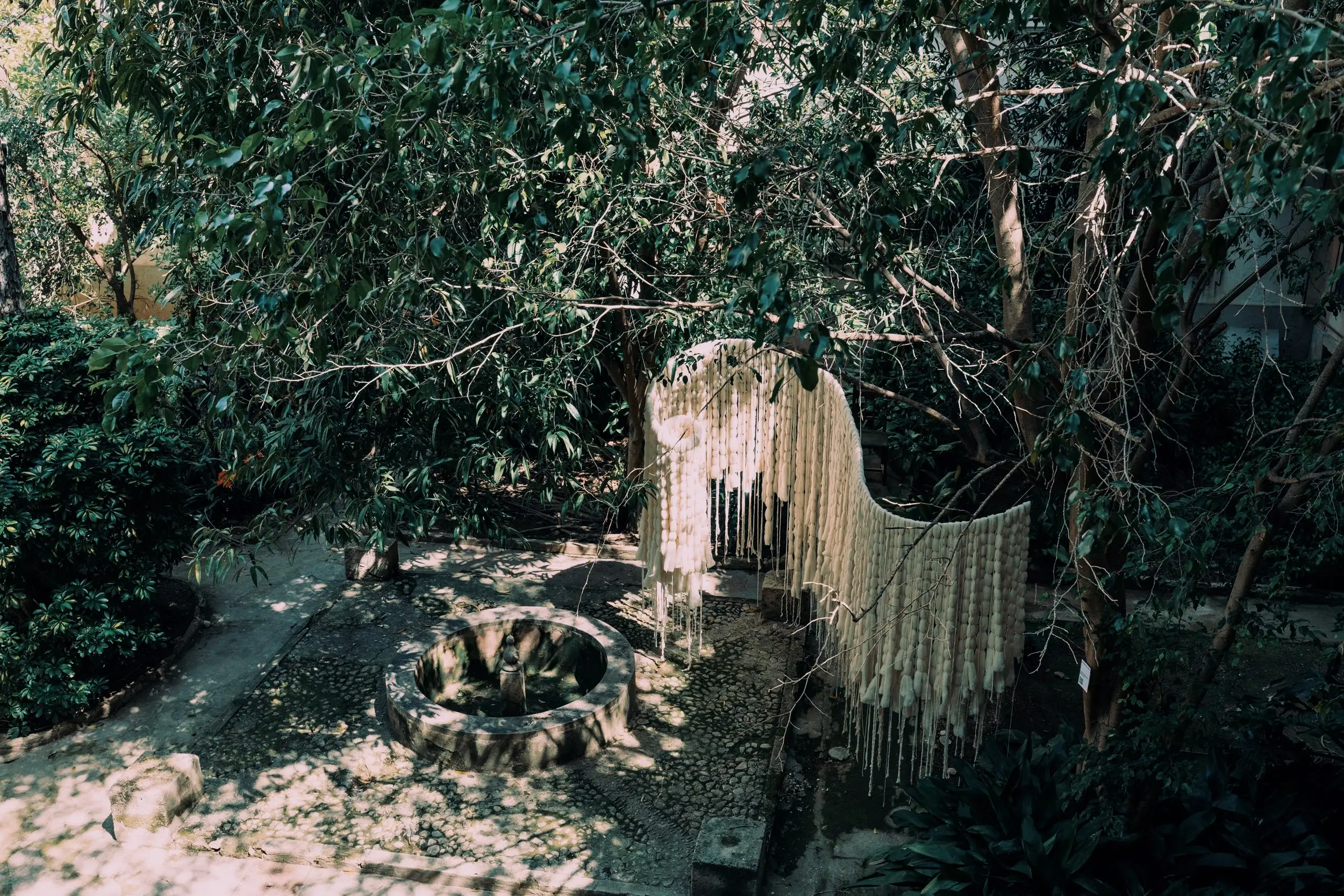
ylvia has woven an impressive, innovative and central feature of the bar-restaurant: a 34-metre curtain made of wool, silk and cotton threads that envelops the central service area (kitchen, toilets and lift),  and allows the living spaces (bar, terrace and restaurant) to flow seamlessly all around it. “I wove in 1.10-metre sections, each weighing 14 kilos,” explains Sylvia. “The bulk of the work is preparing the threads. I work with wool, silk, raw silk and cotton. You have to untangle them and work them. ” It took the artist four months to complete this monumental piece, which irresistibly invites you to touch it. “I really like it when people touch the pieces, because the impact and the contact transform them,” she confides. “Customers will open the curtain to go to the loo or the lift, for example; that’s an integral part of the concept. I work a lot with this idea of wear and the transformation of the material. I’ve just installed a piece outdoors for some clients. We’ve set up a camera to create a time-lapse of how it evolves over time.  What interests me is the material. The thread comes from the earth: it is the root and the essence of a place.”

As Jaime and Paloma began to sketch out the outlines of the Terreno, Sylvia embarked on her artistic exploration of thread. “At the time, I started a series of pieces that I called the ‘Moiras’, in reference to the Greek goddesses who weave the threads of fate and the cycle of life and death. When I started working on them, I wanted to give form to this image through thread, and the light (installed inside the Moira’s structure) came along somewhat by chance to reveal the material. As a result, it became more than just a fabric; it became a luminous sculpture.”

In 2020, Sylvia opened the doors of her studio to unveil this first collection. Among the visitors, a certain José Tatavull stepped through the door. Captivated by Sylvia’s work, he spoke to Jaime and Paloma about it. It was love at first sight. “I was lucky to be noticed by them,” the artist insists. “This hotel project had been in the air from the start, but it took a long time before it took concrete shape. In the meantime, I continued to develop my research.” She created the “Moiras Cosmos”, spiral-shaped pieces, and, little by little, larger, more architectural works, culminating in this final creation that takes centre stage in the Terreno restaurant.

A rapid evolution that has its roots in childhood. Sylvia Montoya has always had yarn in her hands. “In Colombia,” she explains, “there is an extremely rich textile tradition. In my family, my aunts, my grandmother—everyone sewed. My mother, who is an architect, used to weave with her friends. But the real expert is my aunt. She taught me everything about knitting and crochet.” From the age of 7, Sylvia knitted clothes for her Barbies. Years later, after studying design and settling in Paris, she launched her own brand, Warmi (meaning ‘woman’ in Quechua): cutting-edge pieces, designed in the French capital and hand-knitted in Colombia. In 2000, just as fast fashion was embarking on its frantic and destructive race, Sylvia took the complete opposite approach by creating timeless pieces. Each came with a label detailing the name of the artisan knitter, the number of hours of work involved and the technique used.

"I’ve just installed a piece outdoors for some clients. We’ve set up a camera to create a time-lapse of how it evolves over time. What interests me is the material. The thread comes from the earth: it is the root and the essence of a place.”
Sylvia Sánchez Montoya installation at Terreno Barrio Hotel. Photo Grimalt de Blanch