
The idea for Coster did not emerge from a single moment, but rather from a long, almost organic process. It is closely linked to my own trajectory as an artist and to an increasingly clear need to find a space where creation could unfold more freely, more connected to the environment and to time. For me, art is not just an outcome, but a process of listening, attention and dialogue, and this is the approach that underpins the entire project. In that sense, Coster is not conceived as a conventional exhibition space, but as a place where processes are valued as highly as the works themselves.
In this regard, the place itself was key. The finca at the foot of Puig de Maria, I acquired many years ago, was not just a physical space, but a landscape filled with memory, silence and energy. I began to feel that something different could happen there. That art could enter into direct dialogue with nature, without intermediaries and without the pressures of more conventional circuits.
There was also a personal desire to build community, to open processes and not remain solely within individual production. Coster arose from this need to share, to invite other artists to live, research and create together in a context that encourages listening and attentiveness. I find it inspiring to think that everyone who passes through leaves something behind, while also taking something different with them. Ultimately, Coster is an extension of my way of understanding art, yet open to being questioned, expanded and continuously transformed by other perspectives. This flow, this exchange of experiences, is what truly gives meaning to the project.

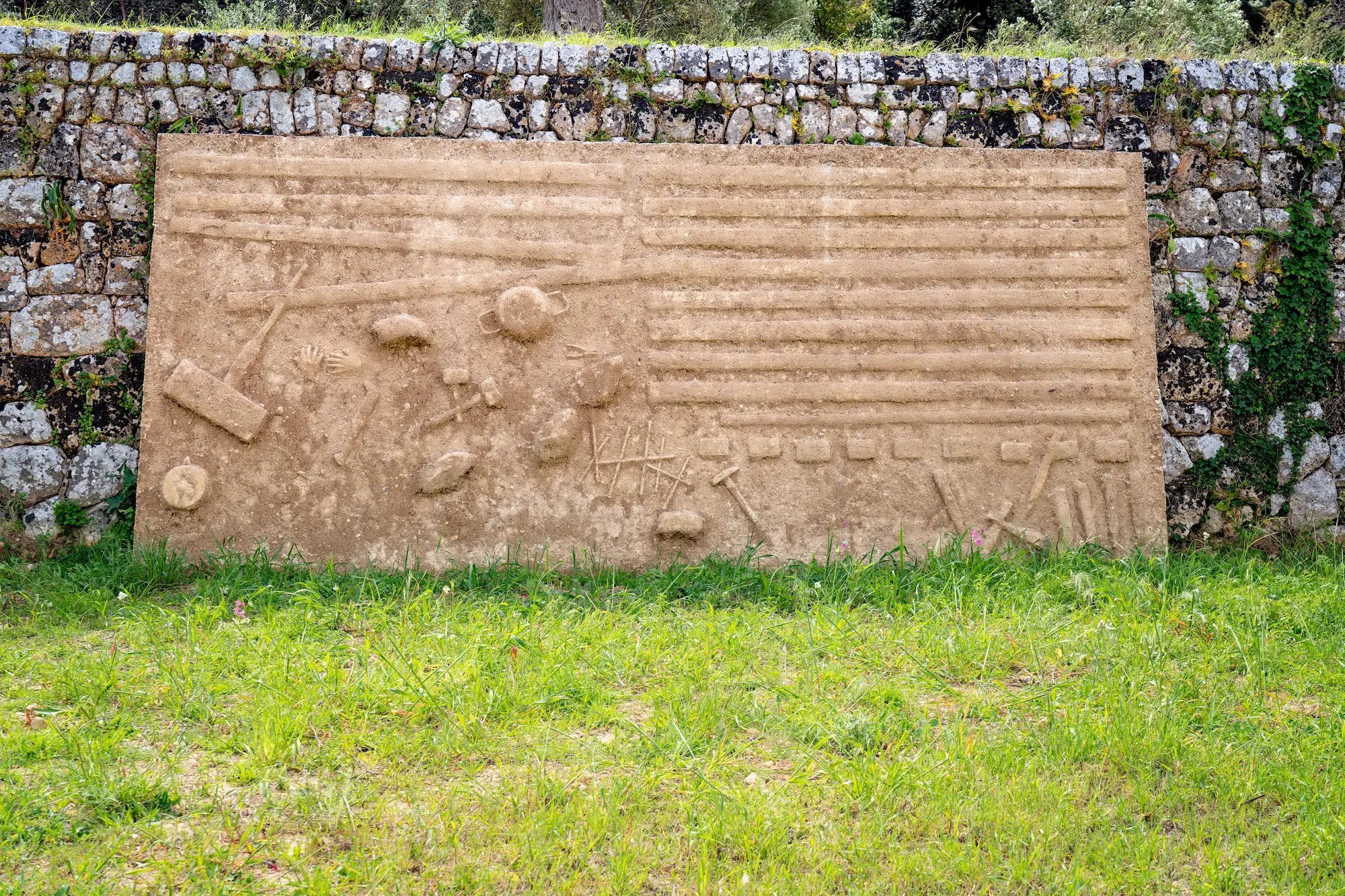
Rather than “bringing” art into nature, I am interested in thinking that art is already part of it, and that what Coster does is create the conditions for that dialogue to become visible and conscious. The relationship I am interested in is not decorative or superficial, but deep and reciprocal. The landscape is not a simple backdrop, but an active agent that influences, shapes and transforms creative processes. At the same time, artistic practice can help us to look at that environment differently, with greater attention and sensitivity. I am interested in a dialogue based on listening, on respect for natural rhythms and on the ability to be affected. An exchange in which the artist does not impose, but relates, observes and responds.
Above all, I would like them to take away a different way of looking and of being. Not so much a fixed idea or a specific message, but an experience that leaves a trace, however subtle. If something remains, I hope it is a heightened sense of attention: towards the environment, towards art, and towards oneself. We live at a very fast pace, and Coster proposes precisely the opposite, a space in which to pause, observe and listen. I am also interested in visitors feeling a sense of connection: with the place, with the processes and with the people. That they perceive art not as something distant, but as something alive, close and in constant transformation. And perhaps, in the best case, that they leave with a new question. Because sometimes that is more valuable than any answer.


Living together, sharing time and working in an environment so closely linked to the landscape and to everyday experience creates bonds that go beyond the strictly professional. Forms of trust, exchange and closeness emerge, which in many cases resemble friendship. What matters to me is that there is a genuine human relationship, not just a functional one. That we can speak about processes, doubts and even failures, not only about results. This creates a sense of complicity that greatly enriches the work. I would say it is a balance. There is a project that structures the relationship, but within it, very real human connections develop, which are a fundamental part of the Coster experience.
It is one of the most important dimensions of Coster. For me, it makes little sense to think of contemporary art as something separate from the context in which it is developed, especially when that context has such a strong identity as the landscape and the local community of Pollença. This community contributes something essential: a direct, everyday and deeply rooted relationship with the environment.
The presence of international artists brings different perspectives, new languages and ways of working that enrich the place. But this energy is only truly complete when it meets the reality of the territory, with the people who inhabit it and with their memory. It is not about “bringing” culture from outside, but about creating a meeting point where both sides are transformed.
Mallorca is fundamental to the identity of Coster, not just as a location, but as a cultural, natural and symbolic landscape. The light, the rhythm of time, the relationship with the land, the dry-stone walls, the history of the territory… all of this is not merely a backdrop, but an active material that runs through the project. The specific place where Coster is located, at the foot of Puig de Maria, also carries a very particular presence. It is a space already filled with memory and silence, and this profoundly shapes the way work is developed there. It is not a neutral place; it demands a certain attitude of attention and respect.
Since 2022, Coster has taken shape gradually, almost as if the project itself was learning how to exist. Over time, the space has gained structure, while maintaining its initial sense of openness and intuition. The residencies, for example, have evolved from something more experimental into a central pillar of the project, with more refined dynamics and greater continuity in the processes.
The relationship with the artists and with the place itself has also evolved. Each edition, each residency and each encounter has contributed to building a kind of memory of the space, which now forms part of its identity. Another important shift is that Coster has found its own rhythm. It is no longer just an idea or a project in development, but a place that is beginning to have its own voice, shaped precisely by the experiences that pass through it. Its evolution has been a process of sedimentation: layering, refining decisions and allowing the project to settle without losing its open and living character.
In the long term, I am interested in Coster consolidating itself not as a closed project, but as a living organism, in constant transformation. A place that can continue to grow without losing its original essence: the relationship between art, nature and territory.
The vision is not to create a “model” to be replicated, but to maintain a space that remains attentive, flexible and open to whatever unfolds over time. A place that can host artists from different generations and backgrounds, and continue to generate processes rather than fixed outcomes.
I would also like the project to deepen its connection with the local environment, not only through art, but through a broader approach to care, research and the transmission of the landscape.
When I walk through Coster, I mostly feel a mixture of calm and attentiveness. There is also a certain sense of strangeness, in the best possible way: recognising something you have seen before, yet discovering it anew because the natural context transforms it. The landscape is not a backdrop, it is a constant interlocutor.
There is also a sense of gratitude, for being able to work in a place like this, for seeing how the projects of other artists gradually integrate into the space, and for the possibility of continuing to discover new layers over time.
.webp)


