Close Search
Mahon Mussels: From the Rope to the Plate
- By
Helene Huret
sustainability 2030
off the island
Mahon Mussels: From the Rope to the Plate
Jul 17, 2026
by
Helene Huret
Mahon Mussels: From the Rope to the Plate
sustainability 2030
off the island
Jul 17, 2026
by
Helene Huret
sustainability 2030
off the island
Mahon Mussels: From the Rope to the Plate
Jul 17, 2026
- By
Helene Huret
Mahon Mussels: From the Rope to the Plate
Jul 17, 2026
- By
Helene Huret
sustainability 2030
off the island
off the island
sustainability
Mahon Mussels: From the Rope to the Plate
Jul 17, 2026
- By
Helene Huret
Photo: Aimery Chemin
O

pposite Mahon, the capital of Menorca, lies the ‘altra banda’ – the other shore. A wild enclave, spared from the onslaught of concrete, where at one time, only the Spanish naval base and modest fishermen’s huts stood side by side. Here, the coastline is indented with deep coves along a unique natural harbour: an inlet over 6 kilometres long and nearly 1.2 kilometres wide. At the end of the road, where the tarmac gives way to a dead end, a path winds its way between two houses. This is where the heart of Muscleres González beats, one of the harbour’s last two mussel-farming companies.

The setting has the air of a northern fjord bathed in southern light. Opposite lies the silhouette of the town; to the right, a few villas blend into the vegetation, from which jetties extend. It is in this idyllic landscape that Paco González, his wife and their staff, work; A family business founded by his father in 1973. Whilst the harvesting of mussels clinging to rocks dates back to ancient times, mussel farming only emerged at the turn of the 19th and 20th centuries. Paco recalls the early days: “My father started out by gathering mussels, razor clams (escupiñas), sea dates (dátiles de mar), the harvesting of which is now strictly prohibited in Europe, and periwinkles. Then he set up his own farm, and in the 1980s, mussel farming really took off in Mahón.”

In the Balearic Islands, the rocky coasts are usually at the mercy of the open sea, offering crystal-clear waters but poor in nutrients. The port of Mahón combines various factors that are highly favourable to mussel farming: this port, one of the largest natural harbours in the world, protects the farms from storms and waves; the island’s barrancs (ravines) discharge fresh water rich in nutrients; and lastly, numerous currents provide the mussels with the oxygen they need to thrive.

“Inside the harbour, we’ve been able to secure the best sites for farming,”explains Paco. “Areas where the currents are particularly strong, with plenty of nutrient-rich fresh water, and the wind that constantly oxygenates the water.”
R

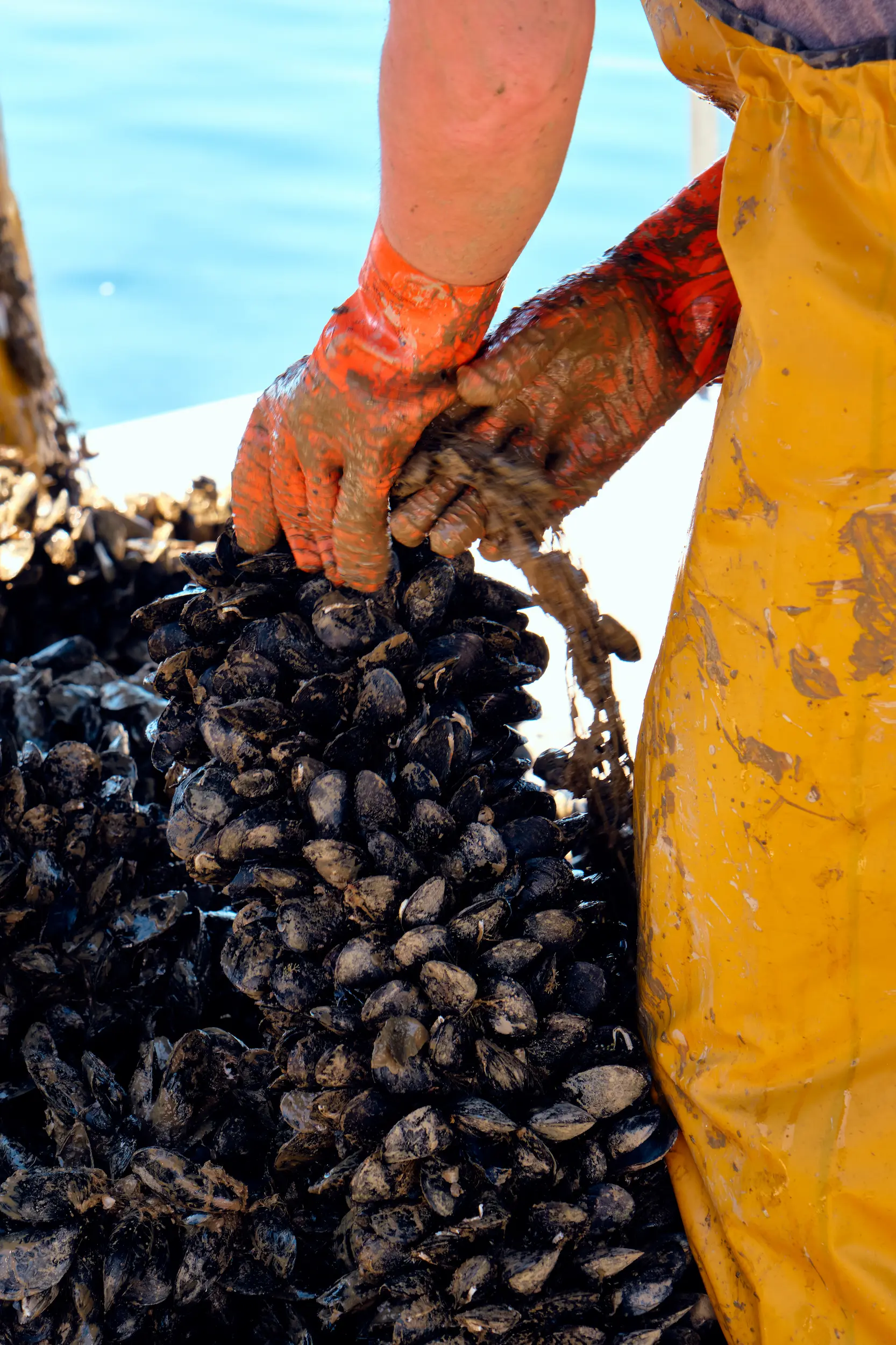
esting on large blue buoys, the rafts consist of evenly spaced wooden beams from which hundreds of ropes hang. “We have,” says Paco, “seven mussel rafts, which my father and I designed. They are particularly long and narrow, so that all the mussels, even those in the middle of the structure, can feed properly.” To reach them, the team boards a heavy flat-bottomed barge fitted with a lifting arm. On the farm, the work is physically demanding. Paco braces himself, grabs the top of a line and hooks it onto the hydraulic crane to haul it up from the depths. Each rope is between 3 and 5 metres long and weighs up to 150 kilos.

“It’s hard, physical work,” admits Paco with a smile. “And in the end, the fish help themselves to their fill, even though nets protect the mussels.”
On board the barge, Paco’s colleagues cut the net as the crane hoists the rope up from the depths. Once the deck is loaded, the boat returns to the quay for the sorting stage. The clusters of mussels are tipped into the funnel of a large stainless-steel machine. Inside the rotating drum, powered by jets of water, the clusters break apart and the shells are washed clean of sediment before passing onto a conveyor belt. There, Paco’s wife manually removes any broken, empty or undersized mussels.

The cycle begins with the purchase, usually in Italy, of tiny spat, baby mussels measuring 2 to 3 centimetres. Placed in long tubular nets, which are a bit like socks, they cling to the central rope using their filaments. As they grow, the bivalves spread out all around the rope. Harvesting begins in April and ends in late July.

Once longer, the season now ends at the end of July. In August, the water temperature rises to levels that are too high, causing mass mortality among the molluscs. “What makes August dangerous isn’t just the temperature,” explains Paco, “but also the increase in maritime traffic in the port of Maó, which puts the mussels under even more stress. This alters the amount of oxygen available and increases vibrations.”

“Inside the harbour, we’ve been able to secure the best sites for farming, Areas where the currents are particularly strong, with plenty of nutrient-rich fresh water, and the wind that constantly oxygenates the water.”
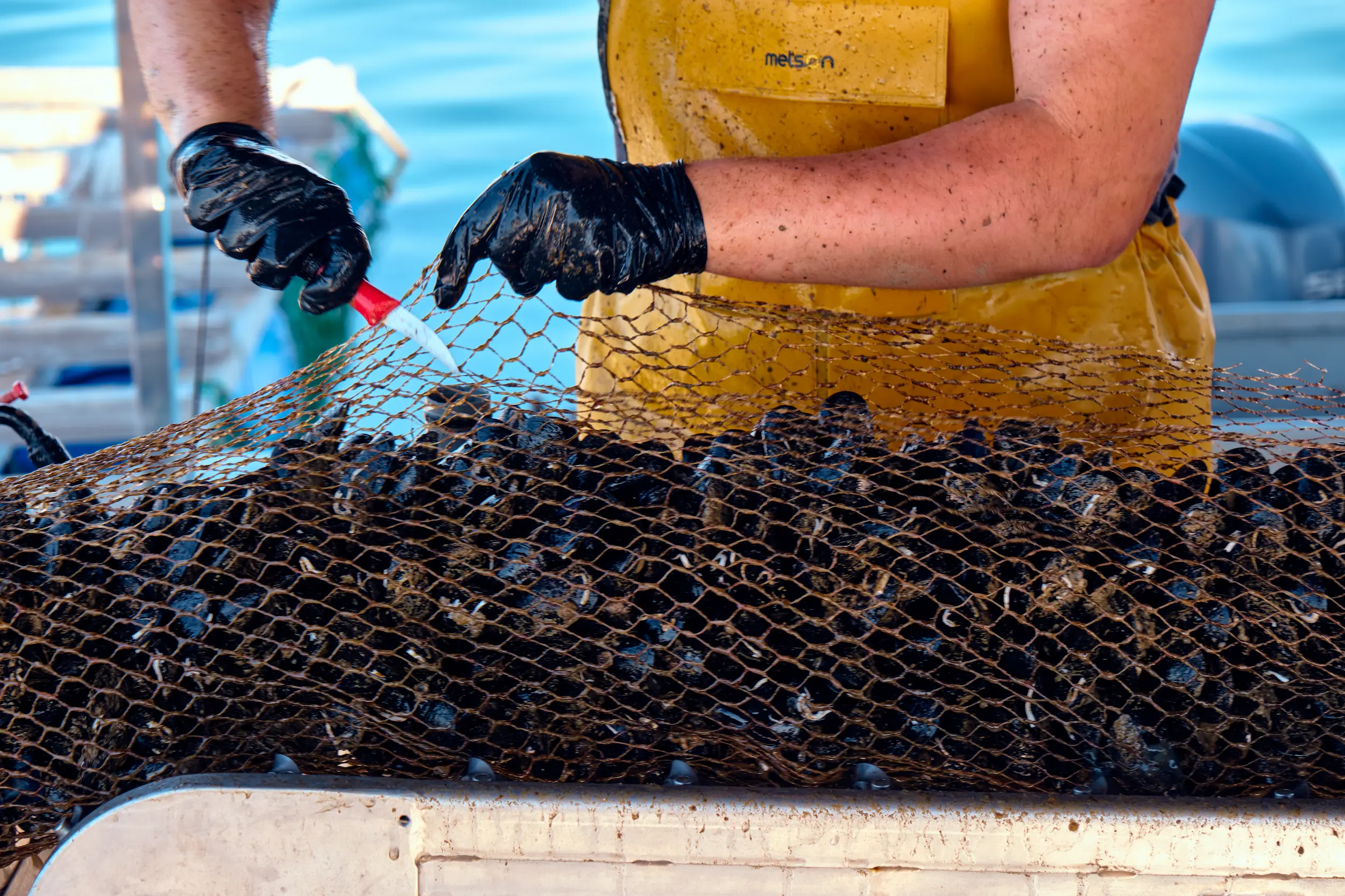
Photo: Aimery Chemin
Related Stories.